The Humidicore™ belongs to a class of heat exchangers known as enthalpy wheels. As the name implies, it’s a wheel, it turns and it exchanges both sensible and latent heat (enthalpy). Enthalpy wheels are most commonly used in HVAC applications where the heat exchange devices recover energy from ventilating exhaust streams. In those applications the temperatures and pressures are near ambient. The Humidicore™ works exactly the same way but is uniquely designed to operate at higher temperatures and pressures with little cross leakage. The main application for the Humidicore™ enthalpy wheel is to humidify incoming gas streams to fuel cells using moisture and thermal energy in the exhaust streams that would otherwise be wasted.
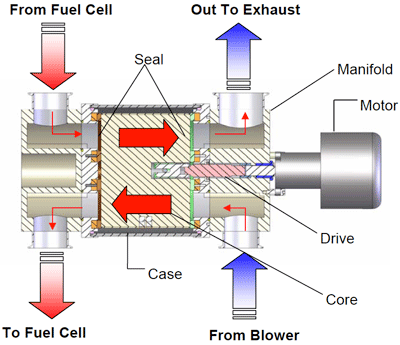
Below is a cutaway view of the Humidicore™. Hot, moist fuel cell exhaust flows through one half of the rotating core. Cold, dry fresh air flows in the opposite direction through the other half of the core. The core is a honeycomb material that allows the air streams to flow through freely. End seals divide the core and minimize cross contamination between the two streams.
View Humidicore™ performance maps
View Humidicore™ testing results
Download a Custom Request Form

The Humidicore™ Fuel Cell Humidifier uses a ceramic honeycomb material. Its dominant chemical composition is Cordierite (2Mg0·2Al2O3·5SiO2). Properties include low pressure drop, high structural strength, dimensional stability, long life and chemical inertness.
In addition, Cordierite is currently in mass production. It is commonly used in automotive catalytic converters and costs as little as 30 cents per cubic inch.
The unique properties of cordierite allow the construction of a simple, inexpensive and almost indestructible enthalpy wheel. The rotor is a unitary cylinder of the honeycomb material shown (left). The contact type end seals act directly against the honeycomb to form very efficient labyrinth seals. The very low thermal expansion rate of Cordierite allows for a precision sealing system by minimizing axial growth during operation.
Emprise currently offers production models of the Humidicore in three different models designed to work with a 3kW, 10kW and 20kW fuel cell. Physical sizes are listed in the chart below:
| 3kW nominal, atmospheric pressure | 3.20Ф x 4” lg |
| 10kW nominal, atmospheric pressure | 5.66Ф x 4” lg |
| 20kW nominal, atmospheric pressure | 5.66Ф x 6” lg |
Other custom sizes are available by request. Each model is constructed largely from plastic and can be powered by either an AC or DC motor. All materials are compatible with deionized water and do not release compounds that are harmful to fuel cells.
Picking the Right Size
Cartridge Details
Manifold Design
Motor Options
Leakage Considerations
Installation Considerations
Field Service
Humidicore Results
How Humidicore™ Works
Picking the Right Size
Cartridge Details
Manifold Design
Motor Options
Leakage Considerations
Installation Considerations
Field Service

The Humidicore™ was recently selected as one of R&D Magazine's top 100 Most Technologically Significant Inventions of the Year.